You’re standing on the tee with a nice, simple swing thought…and then someone behind you starts chatting. A cart creeps up near the green. And the group in front of you is still plumb-bobbing like there’s a jacket on the line.
Most golfers think they know what ruins a round. But the numbers make it pretty obvious: a few repeat-offender behaviors show up over and over because they’re common, they spill over into other groups, and they create real costs downstream.
For example, a survey of 6,800+ golfers found 73% said they don’t follow the rules strictly (61% “sometimes,” 12% “always”)—see the survey results published by Haggin Oaks. And in USGA pace-of-play findings, golfers said they’d pay about ~9.1% more in green fees to save 15–30 minutes of round time. That’s not just whining; that’s basically golfers telling you what they value.
Below is a ranked list of the most annoying things golfers do, weighted by prevalence, impact on others, and downstream effects—including stats like ~48× turf stress from carts versus walking (as reported in GCM’s cart-traffic turf stress coverage) and driver impact noise measured above ~116 dB (from this medical research article hosted on PMC).
How we ranked “annoying”
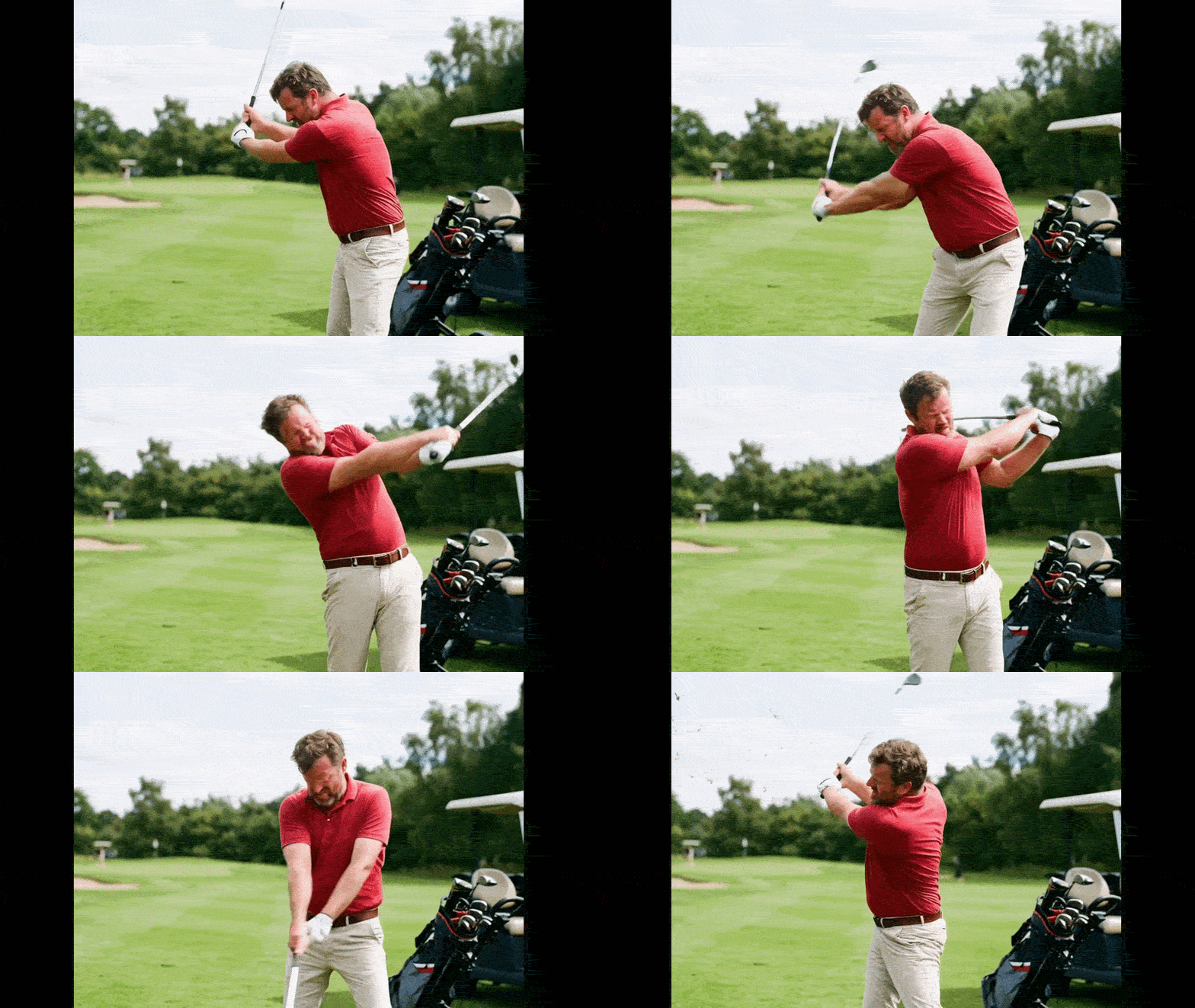
This list is based on three factors:
- Prevalence (how often it shows up in everyday golf)
- Impact on others (pace, fairness, safety, course conditions, enjoyment)
- Downstream effects (cascading delays, turf damage, noise exposure)
Data note: Some sources are separate surveys, and participation counts may overlap (the same golfer could appear in more than one survey). The smallest clear total across studies with explicit sample sizes is 10,388 golfers (Haggin Oaks, National Club Golfer, and the alcohol study), per the Haggin Oaks survey, the National Club Golfer cheating survey, and the PMC alcohol study sample. We also reference a separate GOLF.com rules survey as additional context; it is described as survey responses rather than verified unique individuals.
1) Slow play that backs up the entire course
What it looks like
Endless practice swings. Full-on conversations on the tee. “Searching” for a ball like it’s a missing pet. It’s usually not one big sin—it’s a bunch of tiny delays that stack up until the whole course is in gridlock.
What the data says
- Golfers would pay ~9.1% more in green fees for a round that’s 15–30 minutes faster, based on the USGA pace-of-play findings.
- Operations research models describe the course like a factory system, where one slow group can propagate delays downstream through the tee sheet, as explained in the “golf course as a factory” analysis (Golf Science Journal PDF).
- Time-study research highlights where time tends to leak away—especially around tee boxes and on-green behavior—and points out bottlenecks such as par 3s, per this pace-of-play time-study analysis (Golf Science Journal PDF).
Why it’s annoying
Because you can’t “mind your own business” and escape it. Once the course backs up, you’re living in someone else’s tempo for four-plus hours.
Quick fix
- Be ready when it’s your turn (club picked, yardage checked).
- Park carts/bags so you can walk off the green cleanly.
- If you’re hunting a ball, set a hard limit and keep things moving.
2) Rule-bending that quietly breaks trust (mulligans, gimmies, “improved lies”)
What it looks like
A ball gets nudged out of a divot “because it’s only fair.” A putt gets scooped “because it was good.” Someone reloads after out-of-bounds like penalties are just a suggestion.
Look, casual golf is casual golf. The irritation starts when someone bends rules selectively—and still wants their “score” treated like it’s official.
What the data says
- In a survey of 6,800+ golfers, 73% said they don’t follow the rules strictly (61% sometimes, 12% always), based on the Haggin Oaks survey.
- Among 3,250 club golfers, 62% said cheating exists at their club in some form (perception, not proof of frequency), per the National Club Golfer survey results.
- A rules-focused survey from GOLF.com’s rules-change question to golfers adds more context that plenty of golfers resist strict rules in everyday play.
Why it’s annoying
Because golf only works when everyone’s playing the same game. Once it turns into “my rules when it helps me,” the whole vibe gets weird fast.
Quick fix
- Decide up front: practice round or score round.
- If you want gimmies or a breakfast ball, make it a group rule.
- If somebody else is freelancing the rulebook, it’s often better to skip the argument and just not validate the number.
3) Cart behavior that damages turf (and ignores course rules)
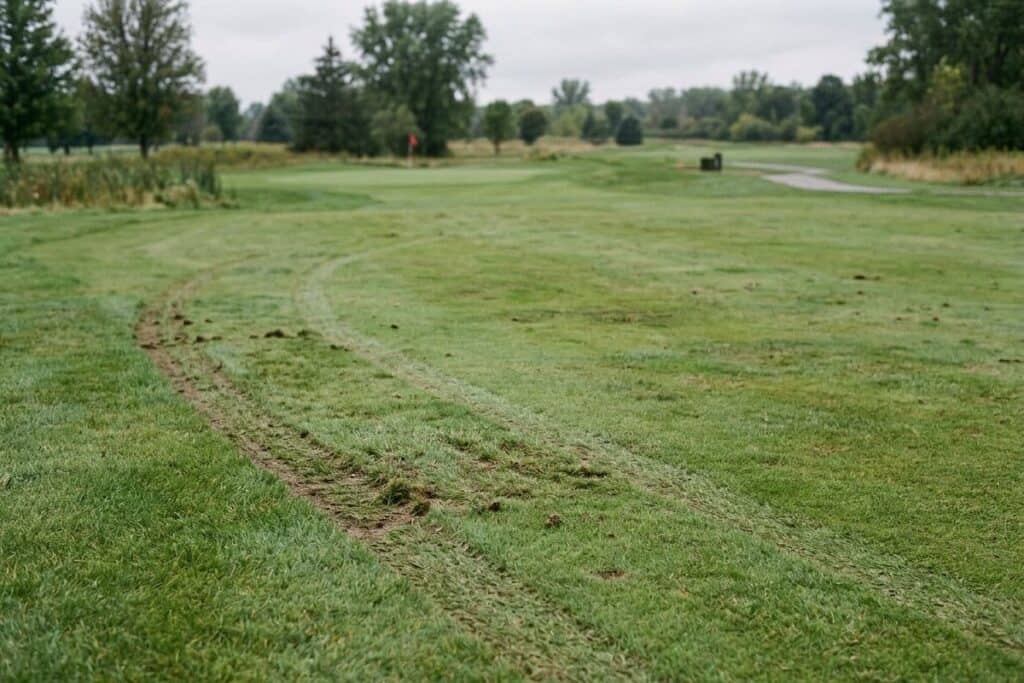
What it looks like
Driving too close to greens and tees, cutting the same corner that’s already beat up, or parking in roped-off zones because “it’ll be fine.”
What the data says
- Research highlighted by GCM reports that a cart can affect roughly ~48× more turf area than a walking golfer, per GCM’s cart-traffic turf stress coverage.
- USGA guidance notes carts can compact soil, thin turf, and create concentrated damage “hot spots,” especially during drought stress or dormancy—and that damage can show even at relatively low traffic volumes when it’s concentrated, per this USGA article on how carts damage turf.
Why it’s annoying
Because everyone ends up paying for it—worse lies, uglier approaches, and more maintenance headaches. And it’s one of those things that screams, “My convenience matters more than the course.”
Quick fix
- Treat cart signs and ropes as non-negotiable.
- Follow 90-degree rules and cart path only when posted.
- Don’t keep parking in the same worn spot every hole—spread traffic out.
4) Noise and distraction on the tee (and yes, it can get loud)
What it looks like
Talking in someone’s backswing. Snack-wrapper symphonies at address. Music that’s basically being shared with three fairways.
What the data says
- A medical research article measuring golf-related sound reported driver impact noise exceeding ~116 dB in some measurements—levels that can raise hearing-risk considerations depending on exposure—see the PMC-hosted research on golf sound levels.
Why it’s annoying
Golf is hard enough when your brain is quiet. When it isn’t, you’re basically making someone hit a shot through a jump scare.
Quick fix
- Default to quiet when someone’s over the ball.
- If you play music, keep it at personal volume.
- Give players space—step back from the “strike zone” when you can.
5) Alcohol-fueled behavior that changes the whole vibe (volume, pace, respect)
What it looks like
A group that starts as “having a good time” and slowly turns into loud, slow, careless, and kind of oblivious—like the course is their private venue.
This isn’t a moral thing. It’s a “don’t drag everyone else into it” thing.
What the data says
- In a study of 338 adult golfers, 84% reported consuming alcohol, averaging ~7.9 servings per week, per the PMC alcohol study.
- The same study found social/status motives were associated with roughly a ~60% higher likelihood of drinking (as framed in the study’s analysis), per the same PMC alcohol study.
Why it’s annoying
Because it tends to amplify everything else people hate: slow play, extra noise, sloppy cart driving, and that “rules don’t matter” energy.
Quick fix
- Keep volume and language course-appropriate.
- Don’t let the cart become a hangout spot—watch your pace.
- If coordination/judgment starts slipping, that’s a pretty clear signal to slow down.
6) The subtle pace-killers: tee-box dithering and on-green marathons
What it looks like
Five-minute reads for a two-footer. Marking, re-marking, backing off, re-reading. Everyone doing a full pre-shot routine like they’re in contention on Sunday…for a $2 Nassau.
What the data says
Time-study research points to on-green time and tee-box behavior as meaningful factors in pace, with certain holes (including par 3s) more likely to create bottlenecks, per this Golf Science Journal pace-of-play time-study PDF.
Why it’s annoying
Because it feels optional. Most people are out there to enjoy the day, not run a full committee meeting over a three-foot putt.
Quick fix
- Read putts while others are putting (without stepping on lines).
- Keep the routine consistent: one look behind, one look beside.
- Use ready golf when it’s appropriate and safe.
Golf is more fun when you feel considered
The best rounds have a steady pace, little pockets of quiet, and that unspoken sense that everyone’s sharing the same space like adults.
And honestly, the research and surveys keep circling the same themes:
- Fairness: rule-bending is common (73% admit to not following rules strictly), and 62% of club golfers say cheating exists at their club in some form, per the Haggin Oaks survey and the National Club Golfer survey.
- Time: golfers would pay ~9.1% more to save 15–30 minutes, and models show delays can cascade from one slow group, per the USGA pace-of-play findings and the Golf Science Journal “factory system” analysis (PDF).
- Shared resources: carts can stress about ~48× the turf area of walking, and damage can appear even with relatively low traffic when it’s concentrated, per GCM’s turf stress coverage and the USGA guidance on cart damage.
- Sensory load: driver impact has been measured above ~116 dB, so yeah—noise and distraction aren’t always “just being sensitive,” per the PMC sound-level research.
- Social spillover: in one study sample, 84% of golfers drank alcohol (average ~7.9 servings/week), and social/status motives were linked with higher likelihood of drinking, per the PMC alcohol study.
If you want a dead-simple “don’t be that golfer” checklist, it’s basically this:
1) play at a steady pace, 2) be honest about your rules, 3) protect the turf, 4) be quiet at the key moments, 5) keep the vibe friendly—not disruptive.
And if you recognize yourself in any of it…welcome to golf. The win is noticing, adjusting, and making the round easier for the people sharing it with you.