You stand at the counter with rental clubs waiting by the door, a sleeve of balls in your hand, and a tee time you booked because a friend finally convinced you to try golf. Then the receipt prints: green fee, cart fee, range balls, maybe a small rental charge.
Total: $87.
For someone who already loves golf, that number might seem normal. For a beginner who may lose six balls, top three drives, and spend most of the day worried about holding everyone up, it can feel like a warning sign.
Golf has a strange problem. It is popular, visible, and growing in many ways, yet it still feels hard for new people to enter. You can watch the sport every weekend, hit balls at a simulator with friends, or play mini golf on vacation, but stepping onto a real course for the first time still comes with cost, time, uncertainty, and a quiet fear of doing something wrong.
That is why the question “why isn’t golf played by more people?” is more complicated than it sounds.
The answer is not that people dislike golf. In fact, many are curious. The issue is that casual interest often breaks down before it becomes regular play. The sport asks for money before confidence, time before skill, and etiquette before belonging.
When golf gets the beginner experience right, it can be beautiful: fresh-cut grass, a ball struck cleanly for the first time, a walk with friends, a quiet hour outside. When it gets it wrong, the beginner leaves feeling embarrassed, rushed, and poorer than expected.
The $87 beginner round is not the whole story. But it is a useful receipt. It shows why golf’s biggest participation challenge may not be awareness.
It may be conversion.
The $87 Beginner Round: A Small Receipt With a Big Message
An $87 round can happen quickly.
Maybe the posted green fee is $49. Then the cart adds another $18. Range balls are $8. A sleeve of budget golf balls is $10 to $15. If you need rental clubs, that can push the day higher. Add a drink or a snack at the turn, and a beginner’s “try it once” afternoon starts to look like a serious hobby expense.
That price does not always mean the course is gouging anyone. Golf courses are expensive to operate. Land, irrigation, mowing, staffing, insurance, equipment, fertilizer, clubhouse operations, and debt all sit behind the tee sheet.
But beginners do not feel the maintenance budget when they tap their card.
They feel the risk.
They wonder: What if I am terrible? What if I slow people down? What if I do not know where to stand? What if I pay all this and only enjoy ten minutes of it?
For regular golfers, $87 buys familiarity. For a beginner, it buys uncertainty.
That difference matters.
Golf Is Growing, So Why Does It Still Feel Hard to Start?
Golf is not dying. That point is important.
The sport has seen meaningful growth in recent years, especially when you include both traditional on-course golf and off-course formats like simulators, driving ranges, entertainment venues, and indoor golf. According to the National Golf Foundation’s golf industry research, 48.1 million Americans age 6 and older participated in golf across on-course and off-course formats in 2025 as described in the National Golf Foundation’s golf industry research.
That is a huge number. It suggests golf has cultural momentum, not a lack of attention.
Traditional golf is also doing better than many people assume. The National Golf Foundation reported that 29.1 million Americans played on-course golf in 2025 in the same National Golf Foundation research, and the PGA similarly highlighted the sport’s reach in its By the Numbers: Golf in 2024 overview, noting that 47.2 million Americans participated in golf in 2024 across on-course and off-course formats.
So the better question is not “why is golf not popular?”
The better question is: why do so many people try golf-adjacent activities, but hesitate to become regular on-course golfers?
Participation Is Up, but Regular Play Is Still a Challenge
A person can be interested in golf without becoming a golfer.
They might go to a driving range twice a year. They might play a simulator during winter. They might watch majors, follow golf creators, or join friends for a scramble. But regular golf requires a different level of commitment.
You need equipment, money, time, confidence, transportation, and enough knowledge to move around the course without feeling lost.
That is a lot to ask before the game starts giving back.
The National Golf Foundation has pointed to both the opportunity and the challenge of new-player growth, including record beginner numbers alongside obstacles such as cost, intimidation, and retention, in its discussion of record beginners and participation barriers.
Golf is attracting beginners. The harder part is keeping them.
Off-Course Golf Is Easier to Try Than Traditional Golf
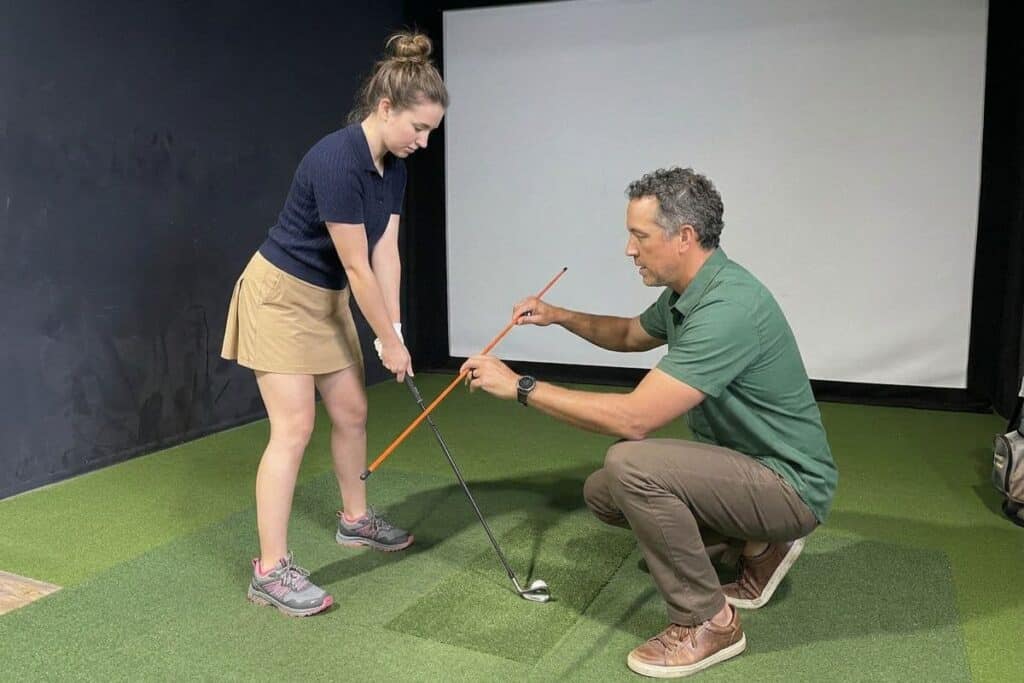
Off-course golf solves several beginner problems at once.
At a simulator, no one behind you is waiting on the tee. At a range, you can hit bad shots without walking after them. At a Topgolf-style venue, the social experience matters as much as the score.
There is music. Food. Seats. Short sessions. Clear pricing. Lower embarrassment.
That is not “lesser” golf. For many people, it is the first version of golf that feels welcoming.
Simulator golf has grown sharply, with Lightspeed reporting that U.S. simulator participation rose 73% since 2019 to 6.2 million users in its look at golf participation growth and off-course trends.
That growth tells us something. People are willing to swing a club when the environment feels simple, social, and low-pressure.
Traditional courses have to pay attention to that.
Barrier #1: The Cost Adds Up Before Beginners Feel Committed
Golf’s cost problem is not only about expensive private clubs.
For most beginners, the real issue is the pile-up of small costs that appear before they know whether they like the game enough to continue.
A first month of casual golf can include:
- Green fees
- Cart fees
- Range buckets
- Balls and tees
- Glove
- Club rentals
- Used or starter clubs
- A lesson or beginner clinic
- Shoes or acceptable clothes
- Food and drink at the course
None of these costs are shocking on their own. Together, they make “just trying golf” feel heavier than trying basketball, pickleball, running, or soccer.
Green Fees, Cart Fees, Balls, Rentals, and Range Buckets
The green fee is only the headline.
Many beginners see a posted rate and assume that is the price. Then they learn a cart may be separate. Range balls may be separate. Rental clubs may be limited or unavailable. Losing balls is also part of the early experience, especially on courses with water, woods, rough, or forced carries.
Lightspeed cited an average U.S. green fee of approximately $43 and reported peak-season rates up 15% since 2021 in its analysis of golf participation and pricing pressures.
Again, $43 may be reasonable for a maintained golf course. But if the final beginner receipt lands near $87, the emotional price feels different.
The beginner is not comparing golf only to other golf courses. They are comparing it to dinner with friends, a gym membership, a movie night, a local league, or a few hours at a public court.
Golf often loses that comparison before the first tee.
Equipment Costs Make “Just Trying It” Feel Risky
Golf equipment can be another wall.
A new player does not need a $1,500 set of clubs. But they do need something. Borrowed clubs help. Used clubs help. Rentals help when they exist and are not treated like an afterthought.
GolfPass breaks down beginner golf expenses, including clubs, lessons, range balls, green fees, and cost-saving options, in its guide to how much it costs to introduce a beginner to golf.
The problem is not simply the total dollar amount. It is the uncertainty around what is necessary.
A beginner might ask:
- Do I need 14 clubs?
- Can I wear running shoes?
- How many balls should I bring?
- Are rental clubs available?
- Should I take a lesson first?
- What if I only want to play nine holes?
If the answers are unclear, the sport feels expensive even before money is spent.
Why $87 Feels Different to a Beginner Than to a Regular Golfer
A regular golfer spreads value across years of experience.
They know which courses fit their budget. They know when twilight rates start. They know how to find used balls, book cheaper times, walk instead of ride, and avoid peak weekend pricing.
Beginners do not know those shortcuts.
They pay the “confusion tax.”
That tax is not always intentional. But it is real. The less clear the pathway, the more likely new players are to overspend, feel foolish, or decide golf is not for them.
Barrier #2: A Round Takes Too Much Time

Golf asks for more than money. It asks for a large block of the day.
A full 18-hole round often takes four hours or more, especially on busy public courses. For beginners, the total commitment can stretch longer when you include driving to the course, parking, checking in, warming up, waiting on the first tee, playing slowly, and getting home.
A “10:20 tee time” can quietly become a six-hour event.
That is hard for people with children, weekend jobs, limited transportation, unpredictable schedules, or only one free afternoon.
The 4–5 Hour Commitment Problem
Golf’s traditional 18-hole format is part of its identity. It is also one of its biggest barriers.
Many modern recreational activities fit into smaller windows. A workout can be 45 minutes. A pickleball match can be an hour. A simulator session can be booked for 60 or 90 minutes. A hike can be as long or short as you want.
Golf, by contrast, often expects the player to adapt to the course’s rhythm.
That can be wonderful when you have the time. It can feel impossible when you do not.
Travel, Check-In, Warm-Up, and Waiting Make It Longer
Beginners also need more buffer time.
They are not sure where to go. They may not know whether to check in at the pro shop or starter. They may need to rent clubs, buy balls, find the first tee, and ask basic questions while feeling like they are already in someone’s way.
Then there is waiting.
Waiting on the tee. Waiting in the fairway. Waiting while faster players stand behind you. Waiting while your friend looks for a ball.
For a confident golfer, waiting is annoying. For a beginner, it can feel like being watched.
Barrier #3: Beginners Don’t Know the Unwritten Rules
Golf has official rules, but the bigger beginner issue is often the unwritten code.
Where do you stand when someone hits? When should you pick up your ball? Can you drive the cart there? Are you supposed to rake that bunker? How quiet is quiet? What does “ready golf” mean? How fast is fast enough?
The USGA offers an approachable introduction to golf rules through Rules 101, but many first-time golfers are not studying rules before a casual round.
They are relying on friends, staff, signs, and luck.
Tee Times, Dress Codes, Etiquette, and Pace of Play
Every step of golf can feel like a small test.
Booking a tee time has its own language. Dress codes vary by facility. Some courses welcome hoodies and speakers; others expect collars and tucked shirts. Some starters are warm and helpful. Others are brief, busy, or impatient.
Then pace of play hangs over everything.
Beginners are told to play fast before they are taught how. They hear “keep up” but not always “here is how to keep up while still having fun.”
That gap creates stress.
Fear of Holding People Up
Many beginners are not afraid of bad shots. They expect those.
They are afraid of inconveniencing others.
That fear changes the whole round. They rush. They skip routines. They stop asking questions. They pick up their ball without understanding the hole. They laugh off frustration because they do not want to seem difficult.
By the end, they may have survived the round rather than enjoyed it.
This is one reason beginner intimidation is such a stubborn barrier. It is not only about skill. It is about belonging.
Barrier #4: Golf Still Carries an Elitist Reputation
Golf has public courses, municipal courses, junior programs, charity events, and affordable leagues. It is not only a private-club sport.
Still, reputation matters.
For many non-golfers, golf still signals money, status, exclusivity, strict rules, and social discomfort. Some of that perception is outdated. Some of it is earned. Either way, it shapes who feels invited.
The PGA’s By the Numbers reporting referenced earlier notes that about 8 in 10 U.S. golfers use public golf options, underscoring how central public golf is to participation.
That is encouraging. Public golf is essential to the game’s future.
But public access is not the same as feeling welcome.
A course can be technically open to everyone and still feel confusing to someone who has never played. A clubhouse can be public and still carry social cues that tell a newcomer to stay quiet, spend quickly, and avoid asking basic questions.
Accessibility is not only a gate. It is an atmosphere.
Barrier #5: Courses Are Not Always Built for Beginners
Golf courses are often designed to challenge skilled players.
That challenge can be part of the fun. But for beginners, long holes, forced carries, deep bunkers, narrow landing areas, thick rough, and fast greens can turn a round into punishment.
A new player who cannot carry the ball over water from the forward tee has not been given a fair first test. They have been given a lost ball and a public moment of failure.
Why Forward Tees, Short Courses, and Par-3 Options Matter
Beginner-friendly design does not mean making golf boring.
It means giving players a realistic path around the course.
That can include:
- Forward tees that meaningfully reduce forced carries
- Short courses where beginners can finish holes
- Par-3 layouts that reward simple contact
- Wider landing areas on entry-level holes
- Clear signage from green to tee
- Beginner scorecards with suggested pickup limits
- Practice areas that mimic real course situations
The USGA makes the case for more playable, welcoming course setups in its article on making golf courses more accessible and enjoyable, and research also points to how course design and social inclusion affect participation, including for disabled golfers, as discussed earlier.
When golf talks about growing the game, it has to include the physical and social design of the course itself.
The Beginner Retention Problem
Trying golf once is not the same as becoming a golfer.
That may be the central issue.
Golf is doing a good job generating curiosity. Major events are visible. Social media clips travel fast. Entertainment golf venues are busy. Friends invite friends. Beginners show up.
But after the first few rounds, the sport has to answer a simple question: was that experience worth repeating?
The National Golf Foundation reported 3.3 million beginners played on-course golf in 2025 as part of its golf industry research, continuing a post-2020 trend of more than 3 million annual beginners. The PGA reported 3.4 million on-course beginners in 2024, the fourth consecutive year above 3 million, in its By the Numbers reporting referenced earlier.
Those are strong signals. But beginner growth is only the first step.
Retention depends on the second, third, and fourth experience.
What pushes beginners away?
Often, it is not one dramatic incident. It is a stack of small frictions:
- They spend more than expected.
- They feel rushed.
- They lose too many balls.
- They do not understand course flow.
- They play from tees that are too long.
- They get paired with impatient strangers.
- They cannot find affordable tee times.
- They do not improve fast enough to feel comfortable.
- They feel like guests in someone else’s sport.
Golf can survive one or two of these problems. But when several happen at once, the beginner quietly disappears.
They do not announce they are quitting. They just stop booking tee times.
What Golf Can Learn From Off-Course Golf
Off-course golf works because it reduces the emotional risk.
You can show up in normal clothes. You do not need to know every rule. You can talk between shots. You can laugh at a miss. You can eat, drink, and leave after an hour. You do not have to keep pace across 18 holes.
That matters.
Traditional golf sometimes treats this as a separate category, but it is also a lesson. People like hitting golf shots. They like the challenge. They like the social side. They like the feeling of one pure strike.
They just may not like the full course experience yet.
The R&A reported more than 100 million golfers in its affiliated markets outside the U.S. and Latin America, including on-course and alternative formats, and it provided additional detail in its Global Golf Participation 2024 report, which counts 108 million golfers across those markets, including 64.1 million adults and 43.9 million juniors.
That broader definition of participation is useful.
Golf does not have to force every interested person directly into 18 holes on a Saturday morning. It can build bridges.
Those bridges might be:
- Range nights for beginners
- Simulator leagues that feed into short-course events
- Par-3 introductions before full courses
- Six-hole or nine-hole social formats
- Scrambles for first-time players
- Group clinics with an on-course follow-up
- Beginner tee times with relaxed expectations
Off-course golf has shown that people want approachable entry points. Courses can borrow that spirit without losing what makes golf special.
How Golf Could Make the Beginner Round Better
Golf does not need to become cheap, easy, or casual in every setting.
Some players love championship difficulty. Some clubs are built for serious competition. Some courses will always be premium. That is fine.
But if the goal is to grow the game, there has to be a clearer beginner lane.
Not a watered-down version. A better on-ramp.
1. Make Beginner Pricing Transparent
A course can reduce anxiety by showing the true beginner cost before checkout.
Instead of listing only the green fee, it could offer a “first round” or “new golfer” bundle that includes:
- Nine holes
- Rental clubs
- A small bucket of range balls
- A sleeve of balls
- Simple course guide
- Optional cart or walking option
The point is not only discounting. It is clarity.
If a beginner knows the full price upfront, the day feels less like a trap.
2. Treat Rental Clubs Like an Invitation
Rental clubs are often a beginner’s first physical connection to the game.
If they are hard to reserve, poorly maintained, or treated like an inconvenience, the message is clear: this place is not built for you.
Good rental sets do not need to be luxurious. They need to be available, usable, and easy to request without embarrassment.
Courses could also explain that beginners do not need 14 clubs. A half set can be enough: driver or hybrid, a few irons, wedge, and putter.
Simpler can be kinder.
3. Offer Beginner Tee Times and Faster Formats
Not every tee time has to serve the same player.
Beginner-friendly blocks could be set aside during slower periods, especially for nine-hole rounds, par-3 loops, or supervised social events. These times could come with clear expectations: pick up after double par, play ready golf, skip a hole if needed, and focus on comfort over score.
This helps beginners relax. It also protects regular golfers who want a faster, more traditional pace.
Better segmentation can reduce conflict.
4. Explain Etiquette Before It Becomes a Mistake
Most beginners are willing to follow etiquette. They just need to know what it is.
Courses could make this easier with simple, friendly guidance:
- Where to check in
- When to arrive
- What to wear
- Where carts can go
- How to keep pace
- When to let others play through
- When it is okay to pick up
- How to repair ball marks and rake bunkers
This does not need to be stern. It can be warm and practical.
A small sign, a short starter script, or a one-page beginner card can turn confusion into confidence.
5. Build From Programs That Already Work
Golf already has strong access programs.
Youth on Course says it provided 1 million low-cost rounds at $5 or less in 2024 through its youth golf access program. Programs like First Tee, Drive, Chip and Putt, and LPGA*USGA Girls Golf also create earlier, friendlier entry points into the sport.
These programs matter because they lower both the cost and the mystery.
They make golf feel learnable.
The next challenge is extending that same clarity to adults who did not grow up around the game.
How Beginners Can Play Golf Without Spending Too Much
The burden should not fall only on beginners. But if you are curious about golf and worried about the cost, there are ways to make the first steps easier.
Start smaller than 18 holes.
Look for:
- Municipal courses
- Twilight rates
- Walking rates
- Par-3 courses
- Executive courses
- Beginner clinics
- Group lessons
- Used clubs
- Range sessions before course rounds
- Nine-hole tee times
- Friends who are patient teachers
You do not need a perfect swing to start. You do not need expensive clothes. You do not need a full bag of new equipment.
A beginner can build slowly.
The best early goal is not a score. It is learning how the course works, making occasional solid contact, and leaving with enough energy to want to try again.
That is how interest becomes habit.
Golf’s Problem Is Not Interest. It Is Conversion.
Golf has a rare mix many sports would love to have: tradition, challenge, outdoor beauty, social connection, competitive depth, and growing cultural attention.
People are interested. The numbers show that. Off-course venues show that. Beginner participation shows that.
But the first real round can still feel like too much too soon.
The $87 receipt is not just about price. It represents the whole beginner burden: money, time, uncertainty, etiquette, pace, equipment, and the quiet question of whether you belong.
If golf wants more people to play regularly, it has to make the first few steps feel less like an exam and more like an invitation.
That does not mean removing everything difficult from the game. Golf should still be challenging. It should still reward patience, practice, and care.
But the challenge should come from the shot in front of you, not from figuring out whether you are welcome before you even reach the first tee.